GLOBAL SERVICE EXCELLENCE DIRECTOR — HARRISON.AI

I've built the function you're hiring for.

Twice.

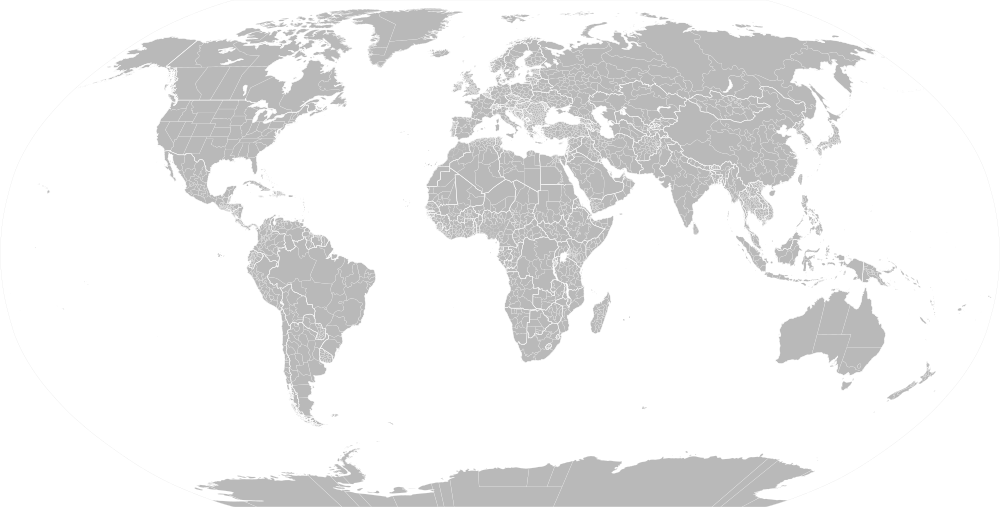
13 years scaling global support organizations from the ground up.
50+ engineers across three continents. 24/7 follow-the-sun coverage.
96% CSAT across 200+ enterprise engagements.
The systems, the teams, the governance — built to last.

5 min read

View My 90-Day Plan

Scroll to see the evidence

Where the work was done

LogicMonitor Firstup Augmentry.ai 4ME Q2 Dell Technologies

The Numbers Behind the Work

Every metric below represents a system I built, a team I led, or a problem I solved at enterprise scale.

75
Escalation Reduction

Executive-level escalations eliminated through governance frameworks

96
CSAT Score

Maintained across 200+ enterprise engagements across three continents

50
Engineers Scaled

From 3 to 50+ across US, EMEA, and APAC

24/7
Coverage Built

Follow-the-sun support model with structured on-call rotations

42
Gross Margin

Business unit turned around from $300K quarterly loss to profitability

87
Onboarding Reduced

Engineer ramp time cut from 3 months to 30 days

85
Cost Reduction

Support costs reduced while improving CSAT from 7.2 to 9.1

128
Revenue Growth

Services revenue scaled from $2.1M to $4.8M in 18 months

WHO I AM

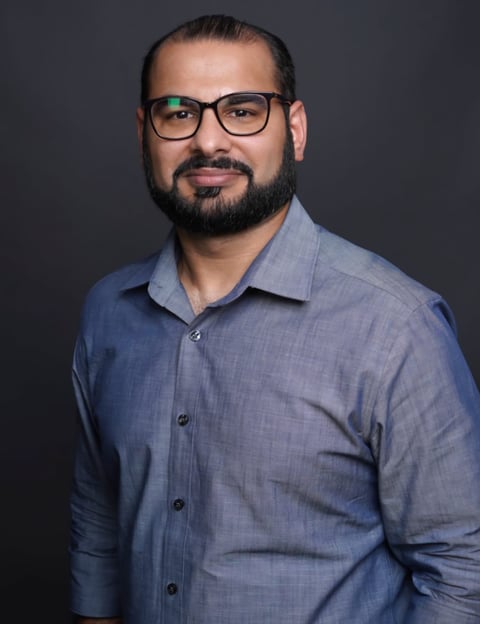
Farjad Syed

Director, Engineering Operations & Services

I've spent 13 years building the kind of function Harrison.ai is hiring for — global service organizations that operate around the clock, across continents, without depending on heroics. The pattern is the same every time: understand the landscape, design the operating model, hire and position the right people, build the automation and governance that make it sustainable, and then get out of the way. I've done this across cloud infrastructure, enterprise SaaS, and regulated environments, and I'm ready to do it again in healthcare AI.

24/7 Operations Follow-the-Sun SLO Governance Incident Management Integration Platforms Cloud Infrastructure Distributed Teams Executive Reporting
Farjad Syed - Director, Engineering Operations & Services

Farjad Syed

Director, Engineering Operations & Services

Follow-the-Sun: How I've Built 24/7 Global Coverage

This isn't theoretical. I've designed and operated this model across three continents with 50+ engineers.

Austin, TX
Loading...
LOADING
London, UK
Loading...
LOADING
Sydney, AU
Loading...
LOADING
0 3 6 9 12 15 18 21 24
APAC
EMEA
AMERICAS
Handoff Handoff
NOW

Live — coverage is always active somewhere

🔄

Structured Handoffs

Every shift transition follows documented runbooks with explicit context transfer. No issue falls through the cracks between zones.

🔧

Unified Tooling

Shared observability, ticketing, and escalation systems mean every engineer in every zone sees the same picture.

🛡️

On-Call Governance

Rotation schedules designed for sustainability — not burnout. Clear escalation tiers with defined response SLOs for every severity level.

The First 90 Days at Harrison.ai

Orientation before action. Validation before change. Proof points before promises.

Days 1-30

Discovery & Orientation

FOCUS: Map the current support landscape, understand integration complexity, and build relationships with cross-functional partners.

KEY ACTIONS:

  • Audit existing support workflows, tooling, and coverage gaps across SaaS, teleradiology, and internal customers
  • Shadow live customer interactions and incident handling firsthand
  • Map the integration landscape (PACS, RIS, worklist systems)
  • Build relationships with Engineering, Product, Clinical Ops, and Customer Success
  • Assess existing on-call and incident management practices

OUTCOME

A clear, evidence-based assessment shared with the CEO, with a recommended operating model direction grounded in observation rather than assumptions.

Days 31-60

Alignment & Prioritization

FOCUS: Translate observations into an aligned operating model and begin standing up foundational capabilities.

KEY ACTIONS:

  • Present proposed support operating model (follow-the-sun, SLOs, escalation tiers, tooling architecture)
  • Begin hiring and positioning initial squad members across time zones
  • Stand up initial SLOs and escalation paths for highest-priority customer group
  • Align with Engineering on the support-to-product feedback loop
  • Scope and begin evaluating the support technology stack

OUTCOME

Shared alignment on the operating model, initial coverage in place, and a clear roadmap for scaling across all three customer groups.

Days 61-90

Momentum & Proof Points

FOCUS: Demonstrate the model works through measurable results while establishing patterns that scale.

KEY ACTIONS:

  • Expand follow-the-sun coverage to all three customer groups with structured handoff protocols
  • Implement initial automation and self-service for highest-volume ticket categories
  • Run first formal post-incident reviews and close the loop on systemic fixes
  • Deliver first CEO-level service health report with SLO performance
  • Establish runbook standards and knowledge management practices

OUTCOME

Measurable SLO adherence, reduced escalation volume, and a service function stakeholders view as a reliable asset.

Patterns, Not One-Offs

The same playbook applied across different companies, different scales, different industries — and it worked every time.

LogicMonitor — 7 Years

Building Global Support from Scratch

When I joined LogicMonitor, professional services was a three-person team. Over seven years, I built it into a 50+ engineer organization spanning the US, EMEA, and APAC with 24/7 follow-the-sun coverage.

The work included designing on-call rotations, escalation frameworks, capacity planning systems, and the automation that made it all scale without scaling headcount at the same rate. Executive-level customer escalations dropped by 75%. Services revenue grew 128%.

This is the closest analog to what Harrison.ai needs — standing up a global service function from first principles with real budget and executive sponsorship.

Engineers 15 → 50+
Escalation Reduction 75%
Revenue Growth 128%
Continents Covered 3

Harrison.ai Relevance

Greenfield build of global 24/7 support organization — same mandate, same scope

Firstup — Post-Acquisition

Stabilizing Delivery Through Organizational Change

Joined during a turbulent post-acquisition period. The PS business unit was losing $300K per quarter. Within my tenure, I turned it to 42% gross margin, scaled the team from 8 to 22 across three regions, and established the delivery governance (PRRs, blameless postmortems, standardized SOWs) that made outcomes predictable instead of heroic.

The lesson: you can build fast if you build the right foundations first. Process before speed. Governance before scale.

Margin $300K Loss → 42% Profit
Team Size 8 → 22
Budget Overrun -50%

Harrison.ai Relevance

Building process-first in a fast-moving environment — same tension between speed and governance

Augmentry.ai — Current Role

Service Excellence at Transaction Scale

Leading engineering operations and services for a platform processing 5M+ monthly transactions. Reduced support costs by 85% while improving CSAT from 7.2 to 9.1. Designed incident response and escalation workflows. Currently serving as executive advisor on operational maturity and platform strategy.

The pattern holds: build the systems, measure what matters, automate what repeats.

Transactions/Month 5M+
Cost Reduction 85%
CSAT Improvement 7.2 → 9.1

Harrison.ai Relevance

Service operations at scale with direct CSAT accountability — same metrics orientation

From Support Function to Center of Excellence

Support is where your product meets reality. The question isn't whether to invest in it — it's whether to build it as a cost center or a competitive advantage. I've always chosen the latter.

Observed Scaling Patterns

Follow-the-Sun Handoff Gaps

Companies building 24/7 coverage for the first time underestimate the operational complexity of time-zone handoffs. Without structured runbooks, shared tooling, and clear escalation ownership, issues fall through during transitions. This is solvable with operating model design.

Integration Complexity as a Support Multiplier

Products that integrate deeply into customer infrastructure — PACS, RIS, EHR systems in Harrison.ai's case — generate a long tail of integration-specific support issues. Without dedicated integration expertise, resolution times stretch and customer trust erodes.

Reactive Break-Fix Before Proactive Governance

Early-stage support organizations operate in break-fix mode without investing in infrastructure to prevent incidents. SLOs, error budgets, post-incident reviews, and ticket deflection strategies are easier to introduce early than to retrofit later.

Center of Excellence Framework

🏗

Operating Model

  • • Follow-the-sun coverage design
  • • On-call rotation governance
  • • SLOs and error budgets
  • • Runbook standardization
🔧

Technology Stack

  • • Observability and monitoring
  • • Ticketing and triage automation
  • • Self-service tooling
  • • Integration support infrastructure
📊

Measurement & Reporting

  • • Time-to-acknowledge, time-to-resolve
  • • First-contact resolution rate
  • • Ticket deflection metrics
  • • CEO-level service health dashboards
🤝

Cross-Functional Feedback

  • • Support → Engineering incident pipeline
  • • Blameless post-incident reviews
  • • Product fix prioritization from support data
  • • Customer voice program

What You're Looking For ↔ What I Bring

"Build and lead a globally distributed engineering team"

Scaled from 3 to 50+ engineers across US, EMEA, and APAC over 7 years

"24/7 follow-the-sun coverage"

Designed and operated follow-the-sun model with structured on-call rotations and runbooks

"Own resolution speed — time-to-acknowledge, time-to-resolve, CSAT"

Maintained 96% CSAT across 200+ engagements; reduced escalations 75%

"Own the support technology stack"

Built automation frameworks reducing engineering effort 20%, accelerating delivery 40%

"Lead teleradiology integrations (PACS, RIS, DICOM)"

13 years of enterprise integration work; demonstrated ability to come up the curve quickly in unfamiliar domains

"Serve three customer groups equally well"

Simultaneously managed SaaS customers, partner ecosystem, and internal stakeholders with tailored service models

"Partner across the business"

Partnered with Sales, Product, Engineering, and Customer Success across every role

"Own major incidents — be the calm, accountable leader during Sev-1s"

ADHD-wired for high-pressure situations; built incident response and post-incident review practices

"Report to the CEO with evidence-based narratives"

Established executive reporting frameworks giving leadership predictable visibility into service health and risk

Why This Role. Why Now.

I want to be direct about two things.

I don't come from healthcare. I want to name that upfront rather than let it sit as an unspoken question. What I bring is 13 years of building the exact function described in this JD — across enterprise SaaS platforms where downtime had real consequences. Healthcare raises those stakes considerably, and I respect that. But the operational discipline transfers cleanly, and I have a track record of coming up the curve fast.

My brain is wired for this kind of work. I'm ADHD, and in a role like this, that's an operating advantage — not a footnote. I absorb new technical domains quickly and deeply. I naturally gravitate toward the details that matter in complex systems. And I'm at my best when things are on fire: Sev-1 incidents, organizational buildouts from scratch, the controlled chaos of creating something new under real pressure.

I have a young family. The idea that the systems I build could contribute to faster, more accurate diagnoses for people like them is not something I take lightly.

I'm ready to build this.

30 minutes is enough to know if this is the right fit.

I've done the work of understanding Harrison.ai's challenge. If this framing aligns with how you're thinking about the role, I'd welcome the conversation.

Schedule a Conversation